Friday, June 20, 2014

Sylvia Plath and Her Bees

   I've been catching up on reading poetry for the last few months. Birthday, Christmas, and a few personal splurges brought good books to my shelves.  Shopping at my favorite used-book store in the Palm Beach County area, Book Exchange, landed me a copy of Collected Poems: Sylvia Plath.  Edited by Ted Hughes, the collection spans the years 1956 to 1963, including a selection of Plath's early poems.
     I confess here, I was compelled to read poems found in this volume because several focused on beekeeping. For those of you who follow Flying Pages, you know I am a back-garden beekeeper and fascinated by honeybees. Her poems resonated with me.
     Sylvia's father, Otto Plath, had been an authority on bumble bees. His book, Bumblebees and Their Ways, (1934) is still highly regarded today. As a boy in Gerany, he had been nicknamed Beinen-Konig (king of the bees) and when he emigrated to the United States, he became a professor of entomology at Boston University. Eventually, Plath's husband, Ted Hughes, took up the avocation.
     The County Dublin Beekeeper's Association offers an account of Plath's immersion into beekeeping. Mary Montaut writes on this site: "For beekeepers . . . the poems are a treasure trove. They are full of fresh, unexpected imagery about the familiar things we take too much for granted in our craft."
     This, as written by Karen Ford while affiliated with the University of Illinois at Urbana-Champaign
Plath wrote the five Bee poems, which she initially titled "Bees" and conceived of as a sequence, in less than a week in October 1962 as her marriage was breaking up. They are unified by their subject matter, bees and beekeeping, and by their five-line stanza pattern, though each poem works its own unique variation of the general theme and form. They reveal a concern with self-assessment and redefinition, both personally and poetically, and proceed by scrutinizing relationships between the speaker and her world. The sequence moves from community, in "The Bee Meeting," to solitude, in "Wintering," as the speaker settles her relations with others and with her own former selves. This trajectory from an external preoccupation with others to an inward concern for the self has formal reverberations. Plath’s characteristic stylistic excess eases during the course of the sequence as the speaker retreats from the pressures of the external world, especially the world of gender conflicts, to the inner rhythms of her own exigencies. As the influence of the exterior world diminishes, the stylistic agitation seems to abate as well.
     Other Plath poems in this collection offer projections, irony, fate, and several are "Confessional" in tone as was found in America poetry of the '50s and '60s.
     What is your familiarity on the poetry of Sylvia Plath? Have you read her Bee poems?

Saturday, June 14, 2014

Cowboy Poetry

     "Here," my writing-group compadre, Don, said as he pushed across the table a small book of cowboy poetry. "I thought you might really enjoy this."
     Settled in for the evening that night, I read the front and back blurbs. I read the Introduction, then let the little book fall open to my first cowboy poem. Before the lamp was cut, I'd read a baker's dozen. Two nights later, I had finished Cowboy Poetry: A Gathering.
     I found most poems to be matter-of-fact, some more honest than others, while a few carried a celebratory tone. Some were grateful. None were woe or pity confessionals.
     Hal Cannon, editor of the collected works, commented in his Introduction:
The poems collected here are both old and new, but they all express an honest spirit which is lean and hard; and their form––the printed words, their rhythm and rhyme as transliterated from the oral––is broken, like a fresh horse, into a manageable gait.
     Cannon continued:
At the heart of cowboy poetry is the memorized performance of traditional poems . . . [and] are based in an oral tradition of performance in both the old and new West. Each poem in this book was written to reflect a real voice, and meant to be heard aloud.
While folk poetry and formal poetry are often judged by different standards, they share the same essential literary aim; the poet is always in search of the best language, the most perfect language, for his subject matter and for his personal poetic intent.
   
     For the last three summers, we have spent vacation in some of the Western states. The last two, we river-rafted the Colorado. The cumulative time spent there brought me up close and personal to that nature-hewn landscape and the people who carved out a living on it––and still do. Reading the collection of these poems refreshed memories and my appreciation of this.
      I grew up with television and Hollywood images of cowboys and their lifestyles. I knew the good guys; I knew the bad guys. Cooks were often drunk, cattle bellowed. And who knew the cowboy? Who knew what took him on his life's journey? Were cowboys hooligans? Toothless civil cast-asides? Were they misfits? Cowboy poetry will dispel all these stereotypes. Cowboy poetry reveals the real thing. No fluff. Generalizations are blown away. These were/are men from ranching families who took pride in their life's job. It continues in some measure to today.
     After a satisfying read spread over a few days, I Googled various cowboy poetry sites. I discovered many. Where have I been all these poem-reading years, I asked myself. What a plethora of wonder and delight awaited me. I provide two links below, plus a brief video. I encourage you to expand your horizons as I did, and enjoy.
 Western and Cowboy Poetry                     Western Folklife

Friday, May 23, 2014

A Poem Before A Break

     With today's Post, I take leave from Flying Pages for the next two weeks. Writing deadlines loom, large house projects begin, and yours truly needs a reprieve to assure these happen without a glitch.
     For the last few weeks, I set aside books of fiction or essays, and concentrated my reading time on  poetry. The first week I gathered some of my favorites, which tend to reflect on real things and real people. Of course, there are many that fill this niche, but to read them all would be like trying to hold water in a sieve––I'd not be able to move onto works written by poets I know well, or those I am not yet familiar.
     Here is one favorite I want to share with you. I hope you will enjoy reading it.

A Blessing


James Wright1927 - 1980
Just off the highway to Rochester, Minnesota,
Twilight bounds softly forth on the grass.
And the eyes of those two Indian ponies
Darken with kindness.
They have come gladly out of the willows
To welcome my friend and me.
We step over the barbed wire into the pasture
Where they have been grazing all day, alone.
They ripple tensely, they can hardly contain their happiness
That we have come.
They bow shyly as wet swans. They love each other.
There is no loneliness like theirs.
At home once more,
They begin munching the young tufts of spring in the darkness.
I would like to hold the slenderer one in my arms,
For she has walked over to me
And nuzzled my left hand.
She is black and white,
Her mane falls wild on her forehead,
And the light breeze moves me to caress her long ear
That is delicate as the skin over a girl’s wrist.
Suddenly I realize
That if I stepped out of my body I would break
Into blossom.
Source: Poets.org

Saturday, May 17, 2014

Typewriting Again

     Tippety-clack-clack/tippety-tap––ZING
     Clickety-clack/clackety-click––ZING
     dot/tap/dot/clack/dot/dot––ZING

     As always, I read the last issue of Poets & Writers from cover to cover––stopping at some articles longer than others before dawdling over the Classifieds.
     In this May/June 2014 issue, Maria Mutch wrote an essay that especially caught my eye. Titled "Ghost in the Machine," the piece relates how she came to own a 1941 Remington 'Streamliner' typewriter, which carried much personal significance. Her remembrance of that particular model, and typewriters in general, resurfaced later in her life. The deep appreciation of it all resonates with me even as I write this.
     I COLLECT. I collect books, friends, fountain pens, plants, bees, wristwatches, Pinterest pins, and––drumroll, please!––manual typewriters. Now, truth be told, I'm early into the gathering of typewriters, and my collection doesn't measure one iota to what others have in their possession. I have to be careful here. There is not enough space in my home for one more bookcase (see Book Care), much less an inventory of manual typewriters (sigh!)––but to be in possession of a few, well now.
     I've been on a mission to find a manual typewriter for the last few years. I put word out on Facebook. Voila!––a writing group friend called to say she had one her father had bought for her when she studied typing/shorthand in school. She said, "I want for you to have it."
Royal 'Arrow' c. 1942
     I brought the Royal 'Arrow' home, and counted its fingers and toes as if it were a newborn. As I did this, I remembered Gloria's story about the meaning this typewriter held for her. Memories surfaced about the typewriters that wove the fabric of my past, and the desire to add a manual to my repertoire of writing instruments. In short order, I began to experience "...the kind of energy that is sometimes contained in things like boats or trees or grand pianos," as Mutch wrote about in her essay.
     I found Alan Business Machines in West Palm Beach. They told me they would be able to bring the 'Arrow' around to clean, oil, and install a new ribbon for me. I'm so pleased. Stay tuned.
Smith-Corona 'Sterling' c. 1935
     I wiled away time between other customer demands on a visit to their store. By chance, I found a treasure trove of vintage manual typewriters tucked away in cases or displayed on counters. I spotted a 1935 Smith-Corona 'Sterling'––rather, ahem! it spotted me. Musty odored nicked and bruised, dust balls rolling with breathing over its innards, letters twisted helter-skelter––but it still had wonderful action. It called to me, from its Art Deco design, for a second life, a forever home. Gotcha, honey! I'll retrieve you in another week or two.
Smith-Corona 'Classic 12' c. 1968

     Then, as if that might be too much for me (or you) to absorb, the universes totally aligned when three days later, in a Goodwill Resale store, I found a Smith-Corona 'Classic 12' in good condition. Guess what? Whoa––pay dirt! And do I need to tell you it was put to use pronto when I got home?
     Maria Mutch seemed content with her find of the typewriter she pursued. Perhaps she'll stay with just that one. As for me, what can I say. So far I've space for these three beauties. I pray addiction doesn't overcome me.
     I've written in the past on writers and the typewriters they've used but, of course, their choices were narrow––pen or typewriter? Please feel free to visit the Posts listed below. And do let me know if you are connected to a typewriter of memory.

Friday, May 9, 2014

Here's Where I'm At

     Easter has passed. Mothers' Day is upon us. Here's where I'm at.
     A beloved pooch and family member, JoJo, passed away on March 26th––thirteen years of age, having persevered multiple Schnauzer disorders.
     I'm thinking resurrection. Not the Biblical or proverbial type, but resurrection from having to think about him. From missing him. Period.
     Today, returning from an appointment, I passed the vet facility that made the first pronouncement on JoJo who had been attacked by a neighbor's German Shepherd two weeks earlier. This hospital told us to get him immediately to an emergency/critical-care vet hospital––a thirty-minute drive away. Fluid, they said, was building in his chest cavity. Something was amiss.
     Seventeen days of visitation rights, tests, aspirations, biopsies, ultrasounds, middle-of -the-night phone calls from vet radiologists, cardiologists, and the "whats and whys" from the Shepherd's owners––in the end we had to kiss JoJo goodbye.
     Nearing the bend in the road this afternoon that led to the first facility, I felt the heat and memory of that day hammer at my spirit. I miss JoJo. Time needs time. And that's where I'm at right now.
     Grieving the loss of a pet who has reached his maximum life is difficult enough. Have you had a pet pass at an unexpected moment, at the hands of something you never envisioned in a million years? Is the loss any different?

Friday, April 25, 2014

Week #3 & #4, National Poetry Month

     For the uninitiated, there exists many poetic forms in the reading world: To name a few––Haiku, Triolet, Concrete, Acrostic, Ballad, Sonnet, Prose, Sestina, Villanelle, Confessional, Free Verse––and the list continues as you walk the courses of time and country. I enjoy discovering new forms, and yes, new forms appear with frequency.
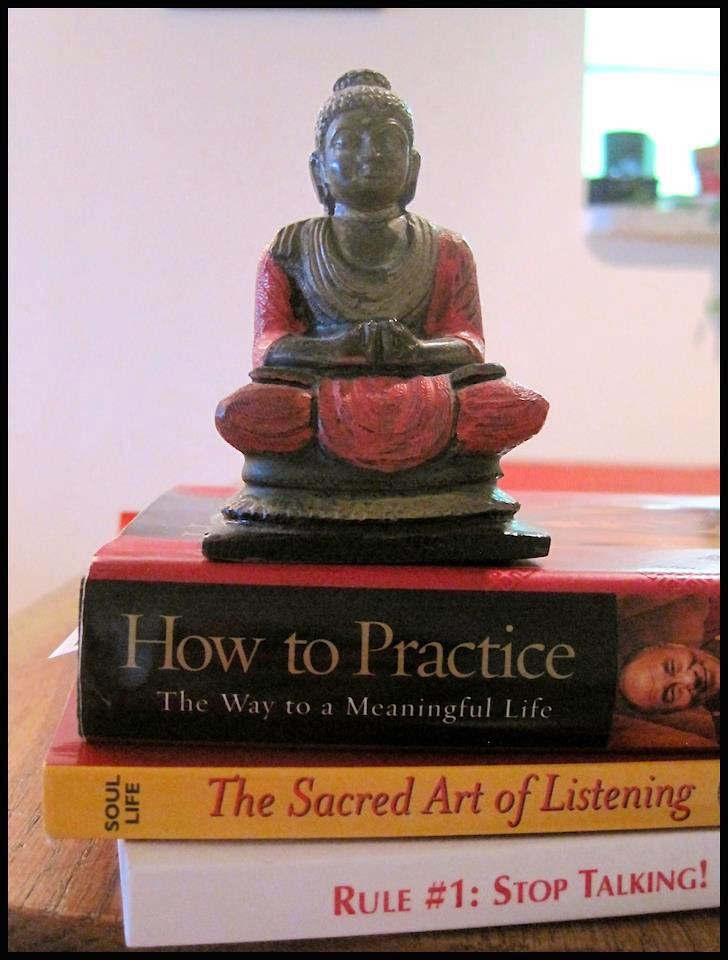
     Within this National Poetry Month, I found this new form: Book Spine Poetry.
     It started in 1993 with Nina Katchadourian's Sorted Books Project. Katchadourian began collecting interesting titles and arranging them in clusters so the spines could be read like a sentence. Maria Popova of Brain Picking adapted the spine sentences into poetry, and the idea quickly spread. Googling the topic will bring you pages of entries to consider. View Forbes Library, which conducts annual Book Spine Poetry Contests for a myriad of results.
     I challenged my writing group to come up with some of their own. They found it wasn't as easy as it first appeared, but did find it an interesting and fun concept. Here are two from my hand.


Below is the Forbes Library 2013 winner in the Adult Category by Linda Eve Diamond.


     The last few weeks have been personal busy/busy––all in good ways. However, it meant I would have to compress two Blog weeks into one. Book Spine Poetry addresses the third week of National Poetry Month, and for this last week of a wonderful poetry-reading month, I inform you that from the purchase of poetry books I recently bought from The Book Exchange (see Week #2, NPM)––I delved into Collected Poems of Sylvia Plath.
     I am an Apiarist. Imagine my surprise when I found that beekeeping was the subject of many of her poems. (Plath's father and her husband (Ted Hughes) kept bees.)
     What about you trying your hand at Book Spine Poetry? I've provided means of finding what's it's all about––so go ahead, try it. As the saying goes, you might like it.