Showing posts with label Typewriters. Show all posts

Saturday, May 17, 2014

Typewriting Again

     Tippety-clack-clack/tippety-tap––ZING
     Clickety-clack/clackety-click––ZING
     dot/tap/dot/clack/dot/dot––ZING

     As always, I read the last issue of Poets & Writers from cover to cover––stopping at some articles longer than others before dawdling over the Classifieds.
     In this May/June 2014 issue, Maria Mutch wrote an essay that especially caught my eye. Titled "Ghost in the Machine," the piece relates how she came to own a 1941 Remington 'Streamliner' typewriter, which carried much personal significance. Her remembrance of that particular model, and typewriters in general, resurfaced later in her life. The deep appreciation of it all resonates with me even as I write this.
     I COLLECT. I collect books, friends, fountain pens, plants, bees, wristwatches, Pinterest pins, and––drumroll, please!––manual typewriters. Now, truth be told, I'm early into the gathering of typewriters, and my collection doesn't measure one iota to what others have in their possession. I have to be careful here. There is not enough space in my home for one more bookcase (see Book Care), much less an inventory of manual typewriters (sigh!)––but to be in possession of a few, well now.
     I've been on a mission to find a manual typewriter for the last few years. I put word out on Facebook. Voila!––a writing group friend called to say she had one her father had bought for her when she studied typing/shorthand in school. She said, "I want for you to have it."
Royal 'Arrow' c. 1942
     I brought the Royal 'Arrow' home, and counted its fingers and toes as if it were a newborn. As I did this, I remembered Gloria's story about the meaning this typewriter held for her. Memories surfaced about the typewriters that wove the fabric of my past, and the desire to add a manual to my repertoire of writing instruments. In short order, I began to experience "...the kind of energy that is sometimes contained in things like boats or trees or grand pianos," as Mutch wrote about in her essay.
     I found Alan Business Machines in West Palm Beach. They told me they would be able to bring the 'Arrow' around to clean, oil, and install a new ribbon for me. I'm so pleased. Stay tuned.
Smith-Corona 'Sterling' c. 1935
     I wiled away time between other customer demands on a visit to their store. By chance, I found a treasure trove of vintage manual typewriters tucked away in cases or displayed on counters. I spotted a 1935 Smith-Corona 'Sterling'––rather, ahem! it spotted me. Musty odored nicked and bruised, dust balls rolling with breathing over its innards, letters twisted helter-skelter––but it still had wonderful action. It called to me, from its Art Deco design, for a second life, a forever home. Gotcha, honey! I'll retrieve you in another week or two.
Smith-Corona 'Classic 12' c. 1968

     Then, as if that might be too much for me (or you) to absorb, the universes totally aligned when three days later, in a Goodwill Resale store, I found a Smith-Corona 'Classic 12' in good condition. Guess what? Whoa––pay dirt! And do I need to tell you it was put to use pronto when I got home?
     Maria Mutch seemed content with her find of the typewriter she pursued. Perhaps she'll stay with just that one. As for me, what can I say. So far I've space for these three beauties. I pray addiction doesn't overcome me.
     I've written in the past on writers and the typewriters they've used but, of course, their choices were narrow––pen or typewriter? Please feel free to visit the Posts listed below. And do let me know if you are connected to a typewriter of memory.

Friday, November 8, 2013

Writers and Their Typewriters, #3

Personal Typewriter; Portable Typewriter Smith-Corona Classic 12 available today. Handsomely styled with sleek, modern lines, it has the solid construction, built-in dependability and advanced features that have made Smith-Corona portable typewriters the first choice of millions the world over. In excellent condition. 
Remington Letter-Riter, a portable typewriter you'll take pride in owning and pleasure in typing. It features 42 keys, and an 84-character keyboard. In good condition.
Seen in up-scale store window
 Boca Raton, FL

     Two internet classifieds among twenty-three advertising the sale of portable, personal, and in-demand typewriters. And that's just on one day, two weeks ago. Typewriters are sought after by young and old––writers, collectors, even store window designers. View this CBS News Video, Typewriter Renaissance, to see what I mean.

     I've attached the following from The John Updike Society, dated June 1, 2010, for your interest:
John Updike’s typewriter is for sale.
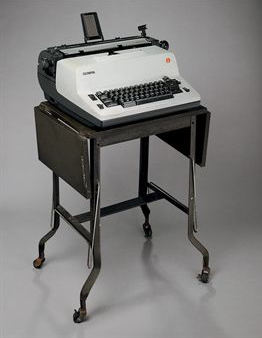
Christie’s Auction House has listed John Updike’s Olympia “electric 65c” typewriter with cover and metal typewriter cart as Lot Number 318 in Sale 2328, Fine Printed Books and Manuscripts Including Americana. The estimate for the typewriter is $4000-$6000. June 22, 2010 is the date of the auction.
The lot description dates the typewriter from 1967-68, probably purchased when Updike lived with his family in London from 1968-69 not long after he wroteCouples. Of interest is the ribbon, which passed only once and recorded a speech for a Gordon College commencement, a paragraph on writing well, a letter regarding an intro he wrote for Kafka’sComplete Short Stories, and a letter to his typist. According to Christie’s, “the typewriter was given to one of his daughters about 15 years before his death.”
Call it a case of bad timing. The Society is in the process of establishing an archive, with several collections already donated. But we’re just a little too new to have the money to purchase something like this to preserve for future museum display.  The Updike typewriter is one of two in the sale, with Jack Kerouac’s priced in the $20,000 range. But the Updike typewriter is priced in the same range as a manuscript of Walt Whitman’s, and higher than a typed and signed letter from J.D. Salinger.
UPDATE:  Christie’s lists the price realized as $4,375 for the typewriter.

I hope I've continued to pique your interest on typewriters with this third in a series (see Writers and Their Typewriters #1  and  Writers and Their Typewriters #2.)
Do you have a typewriter? How did you come by your typewriter(s)? Do you use it, or is it more of a collection item? Tell me, I'd love to know.

Friday, July 5, 2013

Writers and Their Typewriters, #2

     My fascination for typewriters––their intimacy, and the famous writers who have used them in unwavering loyalty––continues to grow. To type a poem or manuscript requires a slower pace with a  typewriter. It also enhances better thinking––stimulating the brain to be mindful of what matters, resulting in fewer mistakes.
     Steve Leveen, founder of Levenger (purveyor of fine reading and writing tools), reproduced in bookend form, the typewriter of historian, David McCullough. For today's post, I've excerpted a portion of what Steve Leveen and Levenger Press Editor, Mim Harrison shared on Steve's blog Well-Read Life on December 3, 2009. It speaks for itself.


“I don’t want to go faster,” writes David McCullough. “If anything, I probably ought to go more slowly.”


Another writer, Carl Honore, realized the value of slow when he found himself contemplating 60-second bedtime stories to read to his toddler. He caught himself in time. “The secret is balance: instead of doing everything faster, do everything at the right speed,” he advises.
David McCullough at work on his typewriter For David McCullough, that means typing “at a pretty good clip,” as he says. And then typing it again, because what he’s really doing is thinking about it some more.
He and his typewriter are, in fact, currently at work on his new book about Americans in Paris. What do you want to bet that as soon as it’s published, that slowly written book will hit the New York Times bestseller list in no time flat. 


I hope I've continued to pique your interest on typewriters with this second in a series (see Writers and Their Typewriters #1).
Do you have a typewriter? If not a typewriter, what do you do or use to achieve a slower pace for better thinking? And last, did you know you can blog with a typewriter? The technique is called "typecasting," but more on that later.

Friday, June 28, 2013

Writers and Their Typewriters #1

Happy Typewriter Day 2013! 
On July 1, 1874, the American inventor, Christopher L. Sholes brought the first commercial typewriter to the market.


     In honor of this landmark event, I write today's Post in Courier font--a throwback to when Courier was one of the few type styles available on typewriters.
**********
     You need to know I - am - a - collector in addition to being a writer, bibliomaniac, gardener, student pianist, and future bee keeper (more on bees later). With my profile in mind, I share that for the last few years I've been on a mission to find a manual typewriter. I haven't the space to collect many, but owning a few to represent different eras, platens, fonts would do nicely. As if I didn't have enough to occupy my brunette-covered cranium, this mission has become more impassioned as of late, and before the year is out it will either be done with, or will have amplified itself. No. Impossible. I haven't the space, remember.
     Stay tuned to Flying Pages as I pursue this quest, and in the process learn more about the machine that led us to computer keypads and boards.
     Because Google is the wonder that it is, I've found the following to share with you. Sit back, close your eyes, and listen to the wonder of an acclaimed sound maker, Michael Winslow, translating the identified typewriters' clicks, clacks, phishes, and phoses. Below is a post by Macy Halford written for "The New Yorker" online blog.
     

History of the typewriter 

The Spanish artist Ignacio Uriarte is interested in office environments. He makes drawings with the four main Bic-pen colors (black, blue, red, green); wall art from envelopes; a piece called “A 100-page Word Document” that is a hundred-page Word document. The most astonishing thing he’s made is this twenty-one-minute film starring Michael (Man of 10,000 Sound Effects) Winslow, whom you may remember from the “Police Academy” movies. It takes us through the history of the typewriter in sound. There’s the crank and creak and “return” of early models like the 1898 Pittsburgh Visible; the soft “choosh choosh” of the 1915 Faktotum Mod. 2; the dark mechanical twang of the 1979 IBM Composer 82. It’s actually a thrilling journey, and a sad one. Machines today—they’re so characterless, aren’t they? My soft-touch keyboard hardly makes any noise at all.


Did you know that Corona(1930-40)once came in colors to rival the iMac? Hmmm, Steve Jobs––I wonder if you knew?!