Friday, June 28, 2013

Writers and Their Typewriters #1

Happy Typewriter Day 2013! 
On July 1, 1874, the American inventor, Christopher L. Sholes brought the first commercial typewriter to the market.


     In honor of this landmark event, I write today's Post in Courier font--a throwback to when Courier was one of the few type styles available on typewriters.
**********
     You need to know I - am - a - collector in addition to being a writer, bibliomaniac, gardener, student pianist, and future bee keeper (more on bees later). With my profile in mind, I share that for the last few years I've been on a mission to find a manual typewriter. I haven't the space to collect many, but owning a few to represent different eras, platens, fonts would do nicely. As if I didn't have enough to occupy my brunette-covered cranium, this mission has become more impassioned as of late, and before the year is out it will either be done with, or will have amplified itself. No. Impossible. I haven't the space, remember.
     Stay tuned to Flying Pages as I pursue this quest, and in the process learn more about the machine that led us to computer keypads and boards.
     Because Google is the wonder that it is, I've found the following to share with you. Sit back, close your eyes, and listen to the wonder of an acclaimed sound maker, Michael Winslow, translating the identified typewriters' clicks, clacks, phishes, and phoses. Below is a post by Macy Halford,  written for "The New Yorker" online blog.
     

History of the typewriter 

The Spanish artist Ignacio Uriarte is interested in office environments. He makes drawings with the four main Bic-pen colors (black, blue, red, green); wall art from envelopes; a piece called “A 100-page Word Document” that is a hundred-page Word document. The most astonishing thing he’s made is this twenty-one-minute film starring Michael (Man of 10,000 Sound Effects) Winslow, whom you may remember from the “Police Academy” movies. It takes us through the history of the typewriter in sound. There’s the crank and creak and “return” of early models like the 1898 Pittsburgh Visible; the soft “choosh choosh” of the 1915 Faktotum Mod. 2; the dark mechanical twang of the 1979 IBM Composer 82. It’s actually a thrilling journey, and a sad one. Machines today—they’re so characterless, aren’t they? My soft-touch keyboard hardly makes any noise at all.


Did you know that Corona(1930-40)once came in colors to rival the iMac? Hmmm, Steve Jobs––I wonder if you knew?!     


Friday, June 21, 2013

Dialogue <> Dialect ~ Accent


     How a character speaks can be just as important as what he or she says. It's important to craft dialogue that is consistent with the characters you've created, speaking in a character's voice when you are in that character's POV––an all-inclusive "voice" that takes in speech, thoughts, and descriptions presented by that character.
     One way to give a character a distinct voice is through dialect or accented speech. Dialect is dialogue spoken either a foreign or regional accent.


     A few years ago, my family and I (two adults, one adolescent) drove from S. FL to Buffalo, NY. We were packed to the hilt with Christmas gifts, suitcases filled with clothes for Upstate NY weather, two dogs, and coolers filled with food and drink. It was a crowded but great trip, and we stopped along the way going and returning.
     A rest stop in Beckley, West Virginia, provided a free handout from Register-Herald journalist, John Blankenship, titled "Rich Sayings Popular Among Our Ancestors Are Still In Use."As a writer, I couldn't pass that up. I still have it for the Eudora Welty-style fiction I'll write one day with characters drawn from West Virginia, and using lines like:

  • a-mite = a bit of something
  • askeered = frightened beyond words
  • battree = needed to start a car
  • schoolin, book read = an education
  • daid = not among the living
  • jeat = did you eat
  • Dawg, I sed come heya = calling a dog
  • Meemaw or Mamaw = grandmother
  • floories  = snow flurries
  • spitten snow = a lot of snow falling
     This valuable five-page handout also provided information about the culture and language of southern West Virginia. For example:
  • the dialect of southern WVA is recognizable for its distinct flattened and merged vowel sounds
  • the dialect results from a merging of Scottish, Irish, English (Elizabethan), and German languages
  • the relative isolation of the mountains for roughly 300 years has ensured the quality of speech that is reminiscent of earlier times.
                                                               **********

     Writing dialect is a skill to be practiced. It requires listening carefully for the spoken words––use, pronunciation, and sentence structure. It's helpful to pick one or two distinctive characteristics to use. If you don't know anyone with the accent you want to convey, or can't travel to that region of the country, consider renting movies or listening to language audio tapes.
     Reading authors who've successfully created regional dialects helps in this process, and more if the author had a firm grasp on the regionalism you might to portray in your character(s). Zora Neale Hurston, Harper Lee, Toni Morrison, Kathryn Stockett, and Eudora Welty come to mind.
     Distinguishing between characters is more than tag-lined dialogue. It also requires attention to mannerisms and the way people speak, their cadence, word choice, and favorite expressions, including foul language.

     As authors, we need to sufficiently characterize the characters we've created, because readers don't want to figure out what's being said. Salt-and-pepper dialogues go a long way in doing this. For example: a character is from Scotland. The author might use a dialogue tag to point our his accent with a mere "(said) with his slight Scottish brogue." Using a handful of words is all it takes to inform readers about his or her accent. So does the occasional hint by the character's use of expressions
     Consider using common idiomatic expressions like the French Zut alors!, Mais oui, Bien, or Voila in dialogues to refresh readers about the character's nationality. This is the most likely way a French person would speak anyway, and using words like these keeps both writer and reader from stressing out.
     Characters who use English as a second language can be portrayed by dialogue with dropped and/or rearranged words, as in: Excuse. Please to tell how far airport is?" This works wonders when used sparingly.
                                                                        **********
Below are a few resources listed that could enhance the use of accented dialogues.

Visit  Visual Accent Dialect Archive (VADA) is a video library of English-language accents and dialects from around the globe that serves performers and linguists studying language sound pronunciation.

Books
Multiple Awards
Songcatcher  skillfully uses dialect/accent in this 2000 drama film directed by Maggie Greenwald. It is about a musicologist researching and collecting Appalachian folk music in the mountains of western North Carolina. It is loosely based on the work of Olive Dame Campbell, founder of the John C. Campbell Folk School in Brasstown, North Carolina, and that of the English folk-song collector, Cecil Sharp, portrayed at the end of the film as Professor Cyrus Whittle. A wonderful sound track is also available. 


Meg Ryan & Kevin Kline

French Kiss star and consummate actor, Kevin Kline, does a convincing accent of a charming Frenchman in this 1995 American romantic comedy co-starring Meg Ryan. It's a fun movie for witnessing accent, hand gestures, and body movement  in the French manner. French Kiss was filmed on location in France, and many characters in the film are English-speaking French people.


I enjoy reading authors who know how to use accent and dialect well in stories. Although I haven't a character with dialect to date, I know what I need to learn to do it successfully and without frustrating myself or my readers. Hopefully, this has helped demystify the use of dialect and accent for your present or future characters.

Friday, June 14, 2013

A Blogging Journey

      I write short fiction, essays, and poetry. I've "apprenticed" for a number of years––taking classes, reading, studying, writing, and revising. I become more polished and build more confidence with every passing day. I feel satisfied.
     With desktop and nightstand topped with the latest Writer's Market, Poet's Market, and writers' magazines, I consume all the know-how before sending my work out into the world. It takes time.
     I belong to a writing group that meets twice a month. More time. The buzz is social media, and not just one site but several. I push the buzz away, but the buzz keeps bzzing. Should I go for it? But I'm so green technically. What should I do? Even deliberating means time.
     It took five years of writing-conference sessions on social media and writers' platforms for me to step up to the plate. After attending the Florida Writers Conference last fall, I returned home intent on:
  1. -- injecting new life onto my Facebook content 
  2. -- rejecting Twitter and a website for the time being
  3. -- using Pinterest to reflect my writing/reading interests
  4. -- christened my first blog Flying Pages.  
********** 

     My blog learning curve was given an appreciated one-two punch by friend, Maxie Steer. With shoulders bent forward, I began to post twice weekly with an editorial calendar planned in advance. Coupled with new life on Facebook and Pinterest, I had a share of new challenges. I recast my window  for writing, and details pertaining to writing. My time became more finite.
     This week marks my seven-month anniversary into the world of blogging, and I have enjoyed and learned from what I research and write for my blog. I have enjoyed and learned from reading other blogs. Still, I find myself betwixt and between.
     Some blogs I've read have hundreds of followers. Their posts have many and informed comments. I felt a competitive edge. I wanted to know who was following me, what were my stats, was I commenting enough on other blogs, were my posts diverse and succinct? The merry-go-round picked up speed. More time. My creative output began to drift.

     I thought about dissolving the blog to return full time to writing, revising, reading; writing and revising some more, but I realized how much I had learned and how I more fully grasped social-media speak. Had this business become an obligation? For the time and effort I expended, would it self-destruct? No. I would continue.
     I cut my posts to once a week. Although I'm still in a learning curve, I'm back to enjoying the challenges of new techie ground and its advantages.
     I shifted attitude gears, and recognized my blog world had opened wider because I had begun to view and comment on other blogs. I began to follow some, and some of them are following mine. Yes, I'd like to know I've provided an "AHA!" moment on any given day. And yes, I'd like to have more people reading and commenting on my blog posts, but I know people read them––or at least I hope they do––because the stats reflect it.
     I'm finding I'm not alone in my search, nor am I walking new ground carving out better organizational skills. I reconfigured my plan, and found value in having walked the tightrope. Every other week, I select one day to write several blogs in advance to take advantage of automatic scheduling. None of this is cast in concrete, mind you. Perhaps in another six or seven months, I'll write that I varied the above by some measure. But I'll be in the driver's seat, controlling what works best for me social-media wise, and its value to my creative output.

At its best, I've come to enjoy the comrarderie of it. Cyber friendships connected by a writing bond. Nice! Now if you could give me feedback, I'd really smile.

Friday, June 7, 2013

Flying Books

Dear Readers:  

     To be sure that your day, and weekend, begins with goodwill towards paper, the printed word, and bindings that we writers treasure so much, I have attached a wonderful 2011American short animated film as a stand-in for my written Post.

     I ask that you remove all that is not life threatening for the next fifteen minutes, and breathe in the beauty of this film––  The Fantastic Flying Books of Mr. Morris Lessmore––that won over a dozen film festivals, and was awarded the Best Animated Short Film at the 84th Academy Awards.  Visit Wikipedia to read on the film/story plot and inspiration.
     An official iPad app (Apple App Store) based on the film is available. A book adaptation is also available.
     Those of you with children, please gather them around, for an indoctrination of the highest order.
     Enjoy!

P. S. The little girl sitting on the stoop at the end––well, that is me. Smile.

Did you enjoy this delightful reprieve at the end of your work week? 

Friday, May 31, 2013

Biblioholic Test

     It's Test Time, dear readers. Are you a biblioholic? Are you an addict? Will you feel, as you read these test questions, that someone has been watching you?
     We're going to get personal here, so the only stipulation is that you must be honest. Cheat on tests like these, and you only cheat on yourself. You might want to have at your side a fine glass (or two or three) of Merlot to fight guilt or the temptation to not answer the way you should. Be as honest as your stomach allows. The grading scale is at the end of each section. Go for it!

YES/NO

  1. When you go to a bookstore with a friend, are you usually carrying more books when you leave than your friend is?
  2. Do you wake up the morning after, unable to remember how many books you bought or how much you spent on them?
  3. Do you ever lie about how many books you've bought?
  4. Do you have at least six books next to your bed?
  5. When a bookstore clerk has been unable to locate a certain book, have you ever been able to find that book on your own?
  6. Are you unable to walk through a mall without stopping at a bookstore?
  7. When at a garage sale, is the first thing you do is look at the books?
  8. When a stranger walks into your house/apartment, are his/her first words usually about your books?
  9. Do you "watch" TV sports with the sound off?
  10. When you watch TV, do you have a book in your lap for slow parts or commercials?
Yes to more than four questions = you are looking down into the deep and woeful pit of bibliophilism.
Yes to more than eight questions = you are hanging by your fingernails on the edge, your legs kicking in the emptiness and your eyes imploringly turned heavenward for rescue.
Yes to all questions = you are in full space now, a full-throated scream careening off the canyon walls, and it's only a matter of time until you splat onto the canyon floor.


Each question here offers three possible answers. Please select only one. Again, honesty is of the utmost. Is it time to refresh the Merlot?

  1. It is bedtime for you and your spouse. You are in bed and the reading light is on above your heads. Your spouse closes his/her book, clicks off the light, and amorously snuggles to your side, promising to bestow upon you ardent connubial favors upon the disposal of your own volume. What do you do?
    1. Lay your book aside and accede to the rigors of your spouse's amatory program.
    2. Agree to your spouse's demands this time, but insist on getting separate reading lights for the future.
    3. Drive him/her away with an NBA-style rebounding elbow, flip the light back on, and return to your tome.
  2. Your book buying has been halted by the barrier that eventually stops all book buying: lack of storage space. How do you react to this problem?
    1. You sell some of the books, or give the away.
    2. You jettison existing space-takers, like furniture and large appliances.
    3. You acquire more space––that is, you buy/rent houses, build annexes, rent storage space.
  3. You have just run out of gas or had car trouble. Following your initial feelings of anger and disappointment, you realize that you may be there for some time. However, you also realize that you failed to bring any books with you. What do you do?
    1. Sit and stew and wait for help.
    2. Read the manuals and insurance policies in the glove compartment.
    3. This would never happen to you as you always have books with you.
  4. When you give a book to a friend as a gift, what do you expect that person to do upon receipt of the volume?
    1. Thank you, put the book aside, and move on to other matters.
    2. Fall to his/her knees in profuse thanks and begin seriously reading the tome immediately, callously disregarding everything and everyone else present.
    3. Listen rapturously while you explain the fine points of the volume––which may include the reading of excerpts––and how they relate to the recipient, before digging into the reading of the tome right there.
  5. What do you do when your friends wish to see your personal library?
    1. Tell them to "go for it" and leave them to their own devices.
    2. You get squeamish when you witness them handling your books, bending them and possibly creasing the bindings, and even setting their drinking vessels on them, but you allow them to continue unremonstrated.
    3. Allow no one to enter your library unless clothed in airtight suits similar to those worn on Gemini space missions, lest they track in any damaging foreign organisms, and you alone handle the volumes.

For every answer (1) give yourself five points; for every (2) selected, ten points; and for every (3) fifteen points. Tally up your score and match it with the following evaluation guideline:

   
        extracted from  
Biblioholism:The Literary Addiction
25-40 Accept our apologies. You are no biblioholic.
41-65 You don't have a problem now. It's only a matter of time.
66 >   You're gone, sorry. Solicit intervention pronto.

I hope you've enjoyed this whimsical testing of your biblioholism. Let me know, because otherwise I won't know to pass along other whimsy tests. Smile and have a great day.


Friday, May 24, 2013

Dictionary~Thesaurus

     Recently, I adjusted the stance of my hardbound reference books––Roget's Thesaurus, Rodale's The Synonym Finder, Webster's New Collegiate Dictionary, and The Chicago Manual of Style––which listed precariously close to the shelf's edge, despite a weighted bookend. Straightened in their place of honor, they are again easy to reach from my desk chair when I write.
     The dictionary and thesaurus are the most frequently retrieved of the above group, and they show the grasped use with chiseled edges, re-glued alpha tabs, and spines working loose. I thought about the role of these two volumes as I made order on that shelf. I wondered if one had become more important than the other, and if so for what reason? To find out, I made a list of what each book contributed to my writing endeavors. I share my findings with you.

DICTIONARY
  • provides an alphabetical list of words with definitions, parts of speech, phonetic pronunciations, and etymologies;
  • you start with a word and look for its meaning
  • its purpose is to define and pronounce words
  • precise words provide articulation to your written voice

THESAURUS*

  • a book of words grouped by ideas
    • you start with an idea and find the words to express it
    • look up the idea word in the index, and find beneath it the closest synonym
    • turn to the numbered section you choose from the index to find synonyms, suitable antonyms, phrases, and expressions
  • provides parts of speech
* the plural of thesaurus is "thesauri" or "thesauruses;" its adjective is "thesaural"

     About the time I was pondering the merits of each of these two volumes, another of John McPhee's articles in his Writing Life series (Draft No. 4) appeared in the April 29, 2013, issue of The New Yorker. I provide a portion of it below, but please note underlines are mine.
You draw a box not only around any word that does not seem quite right but also around words that fulfill their assignment but seem to present an opportunity. While the word inside the box may be perfectly O.K., there likely to be an even better word for this situation, a word right smack on the button, and why don't you try to find such a word? If none occurs, don't linger; keep reading and drawing boxes, and later revisit them one by one. If there's a box around "sensitive," because it seems pretentious in the context, try "susceptible." Why "susceptible"? Because you looked up "sensitive" in the dictionary and it said "highly susceptible." With dictionaries, I spend a great deal more time looking up words I know than words I have never heard of––at least ninety-nine to one. The dictionary definitions of words you are trying to replace are far more likely to help you than a scattershot wad from a thesaurus. If you use the dictionary after the thesaurus, the thesaurus will not hurt you.

I summarize my list, and feel somewhat blessed by Mr. McPhee's remarks:
  • I reach for the dictionary first to be sure the word I've chosen fulfills the definition of my intent. This is the book that presents (for me) the best choice of words.
  • After that, the thesaurus comes to desktop for 1) finding a more nuanced word, and 2) to avoid the repetitive use of a particular word. But even then, I will go back to the dictionary to verify that the new word is suitable.
  • I use the two books hand-in-hand to be sure I convey the right word for the right context and prevent confusion. 
  • In the revision process, the thesaurus works overtime, allowing my writing to have more variety or wordplay, but only when I'm careful.
Do you prefer one word reference book over another? Is it easily at hand? 
I'm curious to know how other writers perceive their dictionaries and thesauri, and why?

Friday, May 17, 2013

Anagrams

     Today's opts, I mean pots, rather spot. No, it was supposed to be stop. Or did I mean tops?

     Okay, I'll start over, but first I'll tell you that today's Post pertains to anagrams. You saw how I was able to flip the four letters of "post" to create five legitimate words (six, if you count the word "post").

     What brought me to this type of word play was an early draft of a new short fiction. I toyed with the title of the piece as an anagram, and later incorporating it into my story. I reconsidered that when it came time to name my characters, and wondered about that effect. The jury is still out on the latter, but I find it intriguing. I'll keep you posted (also read as depots, despot).

     In any event, I explored the nature and history of anagrams, and became more fascinated. Today, I'll share some of what I found with you.

The verb form is anagrammatize.
A person who creates anagrams is an anagrammatist.
     An anagram is a word or phrase formed by rearranging the letters of another word or phrase exactly once. For example,  pages becomes gapes; 
orchestra becomes carthorse; parliament may become partial men. A name like Donna becomes and no or and on; Clint Eastwood becomes old west action, or how about this one, Elvis = lives. The phrase new door becomes one word, and the four points of the compass are thorn, shout, seat, and stew.

     The goal of serious or skilled anagrammatists it to produce anagrams that in some way reflect or comment on the subject. Such an anagram may be a synonym or antonym of its subject, a parody, a criticism, or praise––for example, William Shakespeare = I am a weakish speller.

More by-the-bys:
-- the word "anagrams" is an anagram of "ars magna," Latin for "great art."
-- Wordsmith notes that the right to lampoon royalty and politicians, using anagrams, was enshrined in English law, when King John signed the Magna Carta (Anagram Act) in 1215.

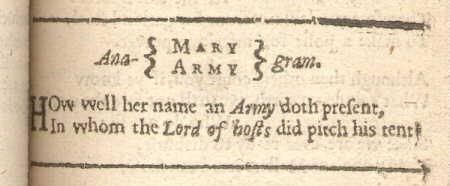
     One of the writing resource books in my Library is The Wordsworth Dictionary of Anagrams, a book of 20,000 words arranged alphabetically, including proper names, compiled by Michael Card. A few anagram sites are: Everyday Vocabulary Anagrams or One Across. Check out one or the other, or all of them. In the meantime, I leave you with this piece of whimsy:

I hope you found this interesting, and that you'll consider using anagrams in your next writing piece whether it's fiction or poetry. At the least, have a go at it to find out what fun is found in creating anagrams, and let me know if you, too, decide to use anagrams in your writing.