Friday, November 8, 2013

Writers and Their Typewriters, #3

Personal Typewriter; Portable Typewriter Smith-Corona Classic 12 available today. Handsomely styled with sleek, modern lines, it has the solid construction, built-in dependability and advanced features that have made Smith-Corona portable typewriters the first choice of millions the world over. In excellent condition. 
Remington Letter-Riter, a portable typewriter you'll take pride in owning and pleasure in typing. It features 42 keys, and an 84-character keyboard. In good condition.
Seen in up-scale store window
 Boca Raton, FL

     Two internet classifieds among twenty-three advertising the sale of portable, personal, and in-demand typewriters. And that's just on one day, two weeks ago. Typewriters are sought after by young and old––writers, collectors, even store window designers. View this CBS News Video, Typewriter Renaissance, to see what I mean.

     I've attached the following from The John Updike Society, dated June 1, 2010, for your interest:
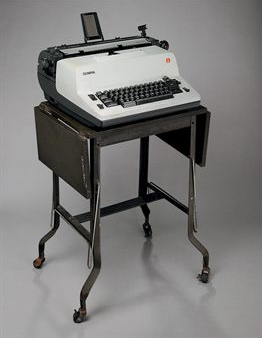
John Updike’s typewriter is for sale.
Christie’s Auction House has listed John Updike’s Olympia “electric 65c” typewriter with cover and metal typewriter cart as Lot Number 318 in Sale 2328, Fine Printed Books and Manuscripts Including Americana. The estimate for the typewriter is $4000-$6000. June 22, 2010 is the date of the auction.
The lot description dates the typewriter from 1967-68, probably purchased when Updike lived with his family in London from 1968-69 not long after he wroteCouples. Of interest is the ribbon, which passed only once and recorded a speech for a Gordon College commencement, a paragraph on writing well, a letter regarding an intro he wrote for Kafka’sComplete Short Stories, and a letter to his typist. According to Christie’s, “the typewriter was given to one of his daughters about 15 years before his death.”
Call it a case of bad timing. The Society is in the process of establishing an archive, with several collections already donated. But we’re just a little too new to have the money to purchase something like this to preserve for future museum display.  The Updike typewriter is one of two in the sale, with Jack Kerouac’s priced in the $20,000 range. But the Updike typewriter is priced in the same range as a manuscript of Walt Whitman’s, and higher than a typed and signed letter from J.D. Salinger.
UPDATE:  Christie’s lists the price realized as $4,375 for the typewriter.

I hope I've continued to pique your interest on typewriters with this third in a series (see Writers and Their Typewriters #1  and  Writers and Their Typewriters #2.)
Do you have a typewriter? How did you come by your typewriter(s)? Do you use it, or is it more of a collection item? Tell me, I'd love to know.

Friday, November 1, 2013

Proofreading

     Have you ever visited "Selling It" on the back inside cover of Consumer Reports? If you haven't, you really should check out an issue in a bookstore or library. "Selling It" is this publication's euphemism for "goofs, glitches, gotchas." It is monthly fodder for the proofreader inside of me. At first, I'm struck by outright laughter––talk of things gone wrong because someone failed to proofread! Then dismay settles in.
     I shake my head wondering how many customers are turned off by grammar or spelling errors. Perhaps it's naiveté that prevents a marketing department from reviewing each word in each line in detail––assuring no typographical or caption mistakes accompany a product's path to the consumer front lines.
     And it's not just Madison Avenue, manufacturers, or promoters who commit these transgressions. Banks, department stores, signage companies, grocery and drug store chains engage in the same. Good, bad, or indifferent, writing errors interfere and compete with messages. They undermine credibility and drive away customers. Costly, costly, and on many levels.

     Then there's you and me, writers of prose. Writers of poetry. For the majority of publications, authors are considered the primary proofreaders.

     Proofreading is the process of reading a text and scrutinizing all its components to find errors in grammar, spelling, punctuation, illustrations, and tables. We're the ones who bear final responsibility for errors and inconsistencies in our published works. Proofreading takes time, extra painstaking time––but it pays off in the end.
     We may be tempted to proofread our own writing, but readers will spot the errors we missed. Even the best writers overlook mistakes in their own writing, and they value a fresh set of eyes to proofread their work before publication. To help mitigate this responsibility, a professional proofreader may be hired by either the author or the publisher.

     Basically, I fall back on a golden "eleven" checklist:
  • I allow for my writing(s) to simmer on the back burner for a while. When I return, I've acquired  a new perspective.
  • I use a printed copy. I can't do proofing/editing/revising on a computer screen.
  • Believe it or not, I read backwards from right to left, one paragraph at a time.
  • I take frequent breaks to remain fresh.
  • I examine one problem at a time––grammar; punctuation; spelling; redundancy; sentence cadence.
  • I've created a checklist.  Punctuation √, Grammar √, Spelling √, Redundancy √, Cadence √
  • One line at a time, I chant. I tackle one line at a time.
  • I use a spellchecker BUT recognize its shortcomings.
  • I trust my dictionary. 
  • I trust my thesaurus.
  • I ask for another set of proofreading eyes.
     Many websites and books provide guides and checklists for how to proofread or what to expect of a hired proofreader. Check out what I've provided below.
Websites:
     http://www.holtuncensored.com/hu/the-ten-mistakes/
     http://www.wordnerds.com.au/2009/06/editing-and-proofreading-whats-the-difference
     http://writingcenter.unc.edu/handouts/proofreading/
     http://www.huffingtonpost.com/kristen-lamb/six-easy-tips-for-selfedi_b_3838124.html?
Books:
     The Essential Guide to Getting Your Book Published
     The Writer's Essential Tackle Box
     The Copyeditor's Handbook

     Proofreading is the last chance to correct mistakes before our readers see them, and the last opportunity to make sure our writing presents the image we want.
     Don't forget: Keep CLAM and Proofread!!!!

Friday, October 25, 2013

Revising/Rewriting

     It's October, and time for revision. I write new pieces––poetry, short stories, or essays through the year. I tweak these pieces through the year. Come November, I dedicate myself to major rewrites on pieces I want to submit to literary journals or competitions in the new year.
     Every year at this time, I bring out the Revising Checklist. I examine a piece's introduction, and its content. I look at the organization for transitions, emphasis, and its conclusion. Style, by way of similes, metaphors, concrete language, repetition and clutter is scrutinized. The same for the mechanics of the piece––punctuation, word and verb usage, and spelling. Revising takes time. It requires getting the words right. It involves more than just correcting errors. It can mean shortening, lengthening, changing or substituting, and in all honesty, it's a messy and frustrating affair. Paper clutter on the floor? Sometimes. Desktop/file overload? Absolutely.


     In revision, I try to make my writing as clear, smooth, and interesting as I can. I must do it. It is in my best interest to revise or rewrite until the cows come home, and every year at this time, I sigh.

Revise ~  verb  1. to look over again in order to correct or improve  2. to make a new, amended, improved, or up-to-date version
Rewrite ~  verb  1. to make a revision  2. to revise something previously written
     
     All good writers revise. All good writers rewrite. Rewriting is an essential part of composing, and in the end it can be the most rewarding part. 

To wit:
- The pleasure is the rewriting.     Joyce Carol Oates 
- If it sounds like writing, I rewrite it.    Elmore Leonard
- I'm all for the scissors. I believe more in the scissors than I do in the pencil.   Truman Capote
- I have rewritten––often several times––every word I have ever published. My pencils outlast their        erasers.    Vladimir Nabokov

So, tell me do you think revision is important to your writing? What is your modus operandi for revising/rewriting your stories, essays, or poem? What steps do you use to make your work become the best that it can be? As always, I love hearing from you.

Friday, October 18, 2013

Famous Writers' Writing Sheds

     I ended last week's Blog post with this: Books and Boards reflect a deep-seated desire to have a secluded, away-from-the-room-filled-with-distractions in which I currently write. Authors of every stripe have or have had their version of a "writer's cave," and for the same reasons I hold for myself. 

     Allow me, in today's post (a post or two will continue this theme), to give a small tour of some of the more famous writers' writing sheds. As I've gleaned sources and images, I see mussed and fussed pages, notepads, and open books strewn on tables, adjacent surfaces, even floors. Their desks, much like my own, lean toward cluttered. In some, there are the rudiments of humanity––radios, ashtrays, cigarette packs, pets, framed pictures, and typewriters. 
     While some writers chose to set up shop abroad to immerse themselves in an undistracted world of prose or poetry, their choices often overlooked vistas of the Alps or vineyards surroundingTuscan villas or perhaps a castle or two. A few set up camp in hotel rooms.
     The writers I'm spotlighting in this and forthcoming posts, and their deified writing huts or sheds, are or were near at hand to each other. Their quaint and simple structures could be reached by a worn path or a short walk from the main house. Crucial to them was the sense of ease, the lifting of a creative web, the necessity of being near to their writing labors. 


Michael Pollan
Michael Pollan's book A Place of My Own is the story of how he built a tiny writing hut for himself in the woods behind his Connecticut house. As he writes on the first page, "Is there anybody who hasn't at one time or another wished for such a place, hasn't turned those soft words over until they'd assumed a habitable shape? What they propose, to anyone who admits them into the space of a daydream, is a place of solitude a few steps off the beaten track of everyday life."Pollan turns his sharp insight to the craft of building, as he recounts the process of designing and constructing a small one-room structure on his rural Connecticut property—a place in which he hoped to read, write and daydream, built with his two own unhandy hands.
Roald Dahl
(Quentin Blake, children's author and illustrator)
I didn't go into the shed very often, because the whole point of it as far

 as Roald was concerned was that it was private, a sanctuary where he could work where no one interrupted him. The whole of the inside was organised as a place for writing: so the old wing-back chair had part of the back burrowed out to make it more comfortable; he had a sleeping bag that he put his legs in when it was cold and a footstool to rest them on; he had a very characteristic Roald arrangement for a writing table with a bar across the arms of the chair and a cardboard tube that altered the angle of the board on which he wrote. As he didn't want to move from his chair everything was within reach. He wrote on yellow legal paper with his favourite kind of pencils; he started off with a handful of them ready sharpened. He used to smoke and there is an ashtray with cigarette butts preserved to this day.
Roald Dahl's writing roomThe table near to his right hand had all kinds of strange memorabilia on it, one of which was part of his own hip bone that had been removed; another was a ball of silver paper that he'd collected from bars of chocolate since he was a young man and it had gradually increased in size. There were various other things that had been sent to him by fans or schoolchildren.
On the wall were letters from schools, and photographs of his family. The three or four strips of paper behind his head were bookmarks, which I had drawn. He kept the curtains closed so that nothing from outside came in to interfere with the story that he was imagining. He went into the shed in the morning and wrote until lunchtime. He didn't write in the afternoon, but went back later to edit what he'd done after it had been typed out by his secretary.
He wrote in the shed as long as I knew him - we worked together for 15 years from 1975 to 1990 and I illustrated a dozen of his books. I would take my drawings down to Gipsy House for him to look at while sitting on the sofa in the dining room. I don't think he let anybody in the shed.

Mark Twain's writing hut is currently situated on the campus of Elmira College in Elmira, NY.
"It is the loveliest study you ever saw...octagonal with a peaked roof, each face filled with a spacious window...perched in complete isolation on the top of an elevation that commands leagues of valley and city and retreating ranges of distant blue hills. It is a cozy nest and just room in it for a sofa, table, and three or four chairs, and when the storms sweep down the remote valley and the lightening flashes behind the hills beyond and the rain beats upon the roof over my head—imagine the luxury of it." - Mark Twain, in a letter to William Dean Howells, 1874


Michael Pollan asks it best, "Is there anybody who hasn't at one time or another wished for such a place...?"

Saturday, October 12, 2013

A Dreamed-for Writing Shed


I want one of these: a dedicat-
ed place to write and create––a modest, outdoor building solidly anchored to the floor of my back garden, preferably near a few trees but not too close to the beehives. It would be a stand-alone place that would take me away from the house both mentally and physically, a haven where I could think or be inspired. 
     I picture this outpost as a poetic vision of a shed––modest of size, yet big enough for two pooches to lounge in my midst. The structure would
reflect me as environmentally friendly, unique, eclectic, and of a loving nature. It would be adorned with a covered porch or deck with a comfortable chair or two, and small-paned windows with heat-reflective glass. There would be no doubt left to the "fly on the wall," as to who occupies this tiny dwelling.

The space would contain deep boards (waist high) braced along two walls to hold a printer and other requisites of writing, with a pull-up chair to help in that process. Above the boards would be built-in shelves or cubby holes for books and files. A cupboard would house supplies, and a cork bulletin board would post notes. Shades or blinds would cool the interior. A carpet, most likely a runner, would cover some floor.
     Electric wiring would run the ceiling fan, printer, a few lamps, an electric teapot, and an under-counter refrigerator. A seating area, probably a used loveseat with a colorful and soft throw on an armrest, would provide a less-rigid place on which to contemplate ideas or to welcome a guest. A small table would sit nearby to hold a mug and a few books.
     For a number of years, I collected home design books filled with ideas for a future one-room writing space. When Pinterest entered my life, I created Cabins 'n Cottages, Retreats, and Writing Cottages boards to which I've pinned other images and plans.
     Books and Boards reflect a deep-seated desire to have a secluded, away-from-the-room-filled-with-distractions in which I currently write. Authors of every stripe have or have had their version of a "writer's cave," and for the same reasons I hold for myself.  I'm set. Now all I need is the money and the permits, because I sure have a plan.

    Have you ever envisioned a nurturing retreat away from the distractions of the home for your writing? Have you dreamed about a small enclosed space, simple in design and surrounded by natural landscape? 
    Check out Tumbleweed Tiny House Company, Nantucket Sheds, and Tiny House Blog for inspiring ideas for yourself.

Friday, October 4, 2013

You Never Know

Recently I responded to a call from Fairchild Tropical Botanic Garden in Miami, Florida:


WIN Elizabeth Gilbert's new novel, The Signature of All Things!
Amazon

"This kind of storytelling is rare––one in which an author can depict the particulars of a moss colony as skillfully as she maps the landscape of the human heart." This is just one of the many amazing reviews for Gilbert's new book, exploring the life and times of a woman who discovers the wonder of botany.

Do you want to win a copy? Tell us about a time when you discovered something wonderful about nature. We're giving 3 copies away tomorrow!


I saw the notice on my Facebook feed approaching 9 P. M. the night before the selection was to be made. I breezed past it, but then paused. Pushing back up the feed, I rested on it and thought: I'm going to do this. All things "nature" run through my blood. I'm going to do this. And I did, and here's what I submitted in 277 words.

After settling into my home on a Florida canal, I began what would become a daily exercise. I’d descend the canal bank and search for all manner of life along its shore and in the water. Among the many fascinating things I found, were flat, thin, oval plates ringed in blue, beige, and gray. To my inexpert eye, I thought they were severed halves of freshwater clams or mussels. I soon learned this flat plate belonged to the apple snail, a freshwater mollusk, and is called an operculum––a cover that slides across the shell’s opening like a retractable door when the snail withdraws into its shell. One memorable day, a snail complied with a live-action demonstration of this when I lifted it from the mud. I caught my breath in marvel.

Apple snails are afoot in your canal, pond, or lake when you find grape-like clusters of pink-to-red eggs on objects above the water. Emerging vegetative stems and pointed cypress knees provide above-water pedestals for the female to deposit ten to eighty eggs packed in a gelatinous mass to keep them safe before they start life on their own. The young snails appear after two weeks, drop into the water as mini-versions of their parents, and quickly grow to adult size. They want to live with a passion.

For the shore-wading limpkin (also found in my back garden), it’s an important food source. For the snail kite cruising on the wing over water, it’s this bird’s only food. Apple snails are an integral part of Florida’s lake, pond, and marsh life. They are a part of my life, also.
I wrote it. I submitted it, and I won one of the three copies. If I hadn't, I would not have won. Simple as that.

But here's what I really won––I took a small, calculated risk to submit something I believed in, entered a mini competition to test my "flash" writing, and had in my hands (within two days) a hardcover book by an acclaimed author. It tasted and felt sweet.

Fellow writers, enter small competitions with your words knowing big-time fame might not come of it––but the validation of a crafted piece will bolster your writing efforts. And, don't forget to enter the big ones along the way. Either way, if you don't, you'll never know. 

Friday, September 27, 2013

Word Parts ~ Suffixes

     I'll try to suppress my enthusiasm for suffixes in this week's post, but I hope you'll understand if I get carried away.

     Suffixes (Suf means "after") are added to the end of a root or existing word. Suffixes (like prefixes) are not words in their own right. They cannot stand on their own in a sentence. When typed, a hyphen typically precedes them.
   
Their beauty is twofold:
  • they give new meaning to an existing word; and,
  • they indicate certain parts of speech
     For example:
Noun                                Suffix (Meaning)                             Adjective          
fate, sin                              -ful (full of)                                      fateful, sinful                                      
patriot                                -ic (one having the character of)      patriotic                          
sweaty                               -y (characterized by)                        sweaty
manage                              -able (capable of, able to be)           manageable
fiction                                -al (relating to)                                 fictional
child                                  -ish (of, relating to, being)                childish

     The suffix: -ion (pronounced shun) indicates the word's part of speech is a Noun. Words ending in
-ion, -tion, or -sion means that the given word will have in its definition in the act or process of; state or condition of. Using the word production, I can deduce that it's a noun, and that it's the process of producing. Here are a few others you can try to deduce their meanings: hydration, diversion, expansion, fusion, or orientation.

    As mentioned in last week's Post (please see Word Parts ~ Prefixes), once learned, these word parts help in understanding the meaning of words you don't know. Analyzing a new word for its meaning in this way should be confirmed with your dictionary.


Consider these handy reference books available at Amazon or learn more about prefixes and suffixes on the web at
http://www.prefixsuffix.com.


Once again I ask: Are you surprised at how many words you knew?