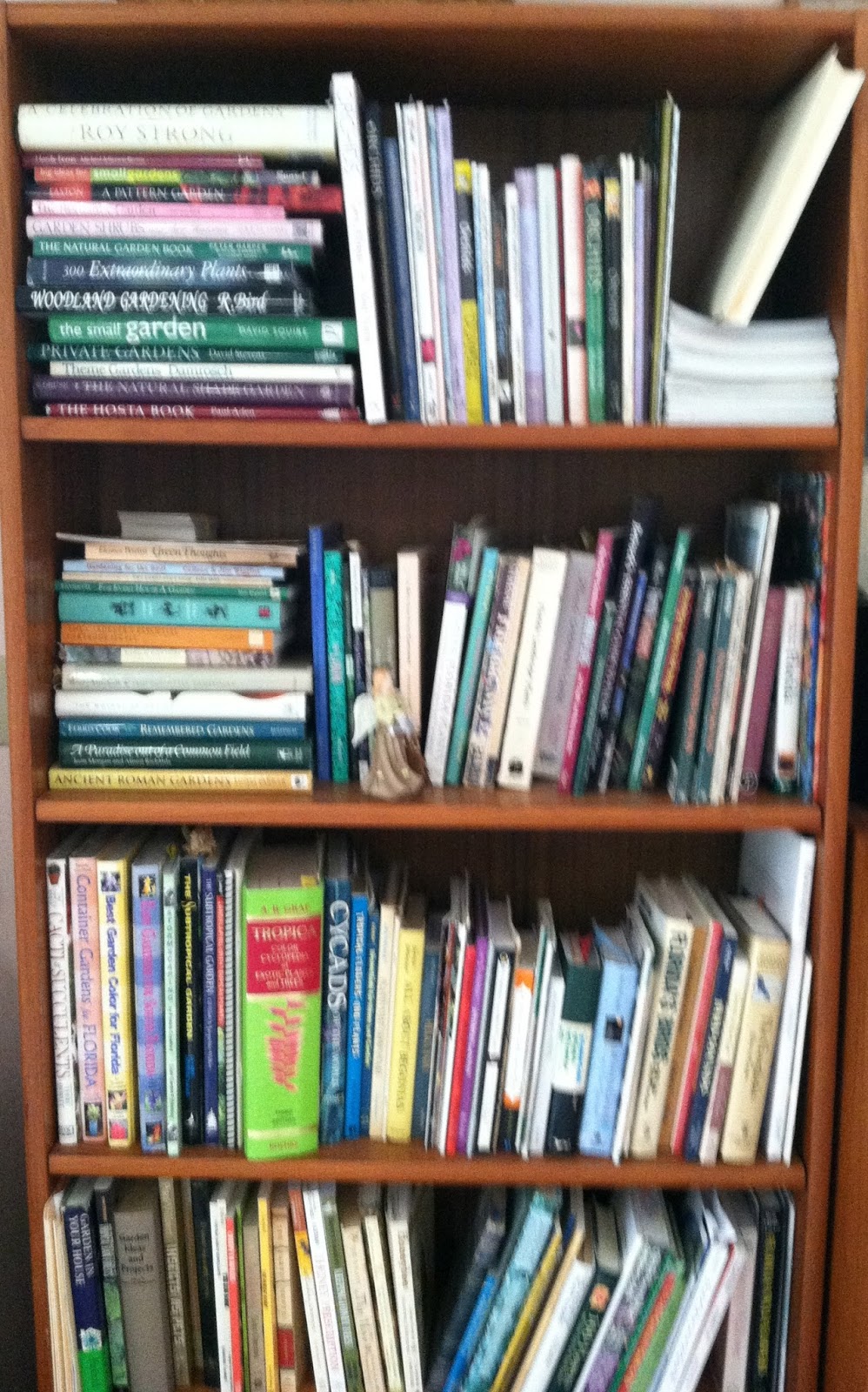
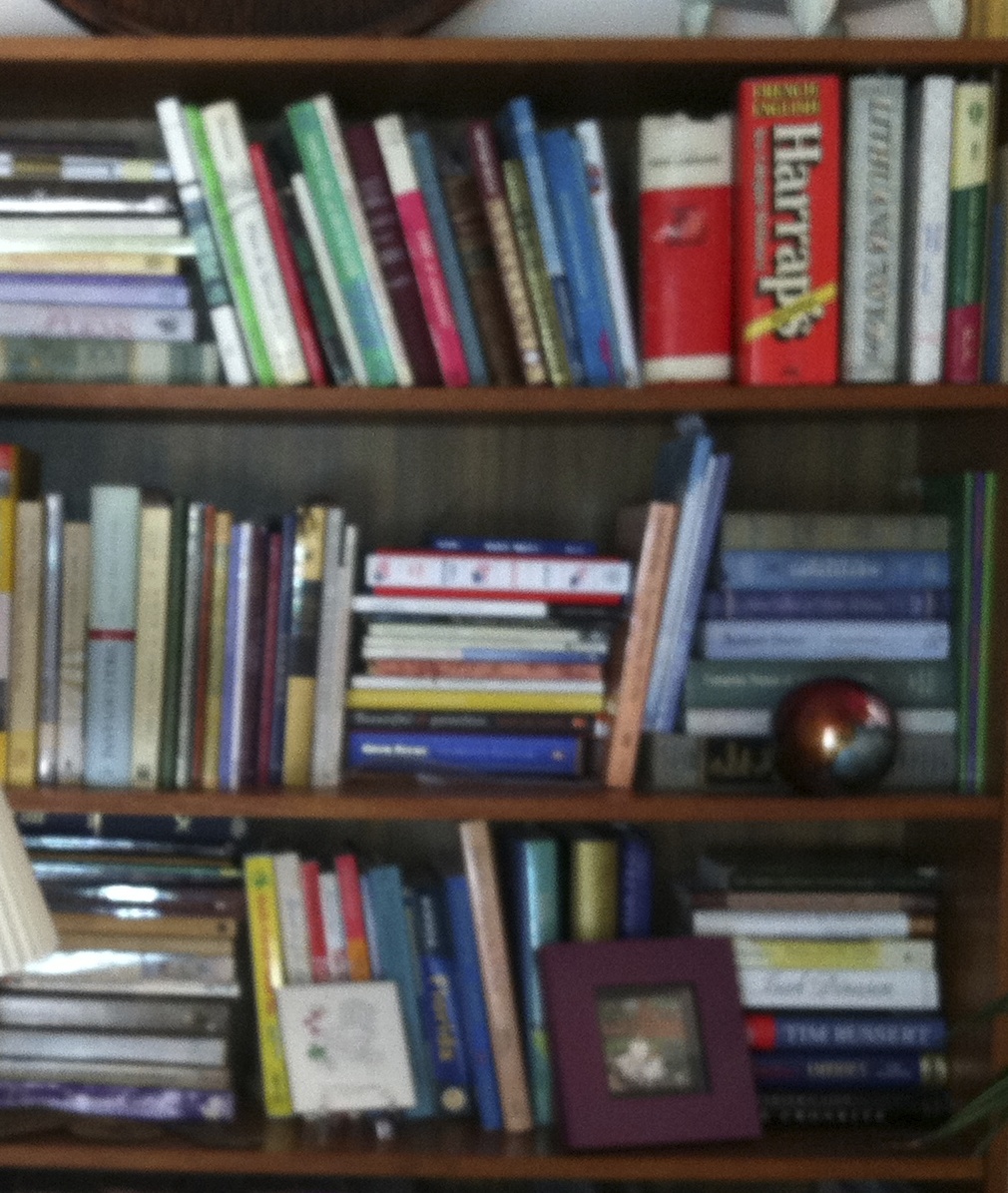
I began purchasing books soon after my first paycheck. Hundreds of paychecks later, I'm still in the book-buying game. I covet books. When I walk past a bookstore in a shopping plaza, my whole being pulses like a divining rod. I lack the discipline to walk past it, because I know what waits inside for me. Nothing can be as soothing as a few hours spent in the shop of delights, and I never leave empty-handed. There is always a book I don't have, and that book needs me.
The evolving collection of books reflects my idiosyncratic interests, curiosities, and hobbies. I have books about honey bees and beekeeping, travel (near and far), raising parakeets, freshwater fish, cats, and dogs. I have books on South Florida vegetation (orchids, palms, ferns, trees, gingers), and wildlife (snakes, turtles, birds, butterflies). Four shelves are dedicated to history (U.S. and foreign), urban planning, architecture, architect mongraphs, and U. S. historic buildings), and another two hold cookbooks (I love to cook!). Did I mention two bookcases (five shelves each) are dedicated to creative nonfiction, fiction, poetry and poets, humor, and many literary journals? Also, my needs as a writer have increased exponentially the last few years, and I now possess books addressing specific writing issues. They, too, have shelves.
My home has become a repository for the passion for books. Stacks of books lend warmth and comfort and a modicum of disarray to our rooms. How satisfying it is when occasionally a book is needed to "verify something," and verification can be found a few steps away.
Last week in Book Care: Horizontal vs. Vertical vs. Jumbled Up, I noted every room in our home contains a bookcase––some cases larger than others with some rooms having several. Available space, both in the house and on shelves, is a problem. I've wrestled with this for a while, and decided it's time to thin out the books. It's not a welcome task. I can readily part with accumulated "stuff"(knick knacks, CDs, DVDs, clothes), but find it far more difficult to part with books.
 I'm the avid book reader in the family, and therefore have the most books. I know I need to part with them, but part with them where? I'd be happier if I could consolidate, but consolidate them where? I'm thinking it's a challenge I'll take with me until I'm six feet under. I know people who list their books on ebay or Amazon, but I'm of the local mentality. If I'm to part with them, then I need to know they're nearby. My husband and I are giving serious thought to building a Little Free Library in our front yard. It'll help in some instances, but not all.
For the time being, I've committed myself to more library visits, and less book-buying. I own many books of fiction. I've read most of them, but I probably won't read many a second time. These will find a another home. Reconnecting with my library would allow me to borrow a book, and if it sweeps me off my feet, I can always buy it later. As with thoughts of a curbside library, I'm thinking of purchasing a digital reader for newly-released books. Between parting with bought books, falling back on library borrowing, and the purchase of a digital reader, I might be able to stem the tide of book overload.
I'm working toward more than one solution for book overflow. Are you? What ideas can you share?